
Remote Patient Monitoring (RPM) for medical practicesContinuous care,
quietly delivered.
FDA-cleared connected devices collect vitals around the clock. Our clinical team and platform turn that stream into actionable signal for your providers.
What the RPM platform actually does.
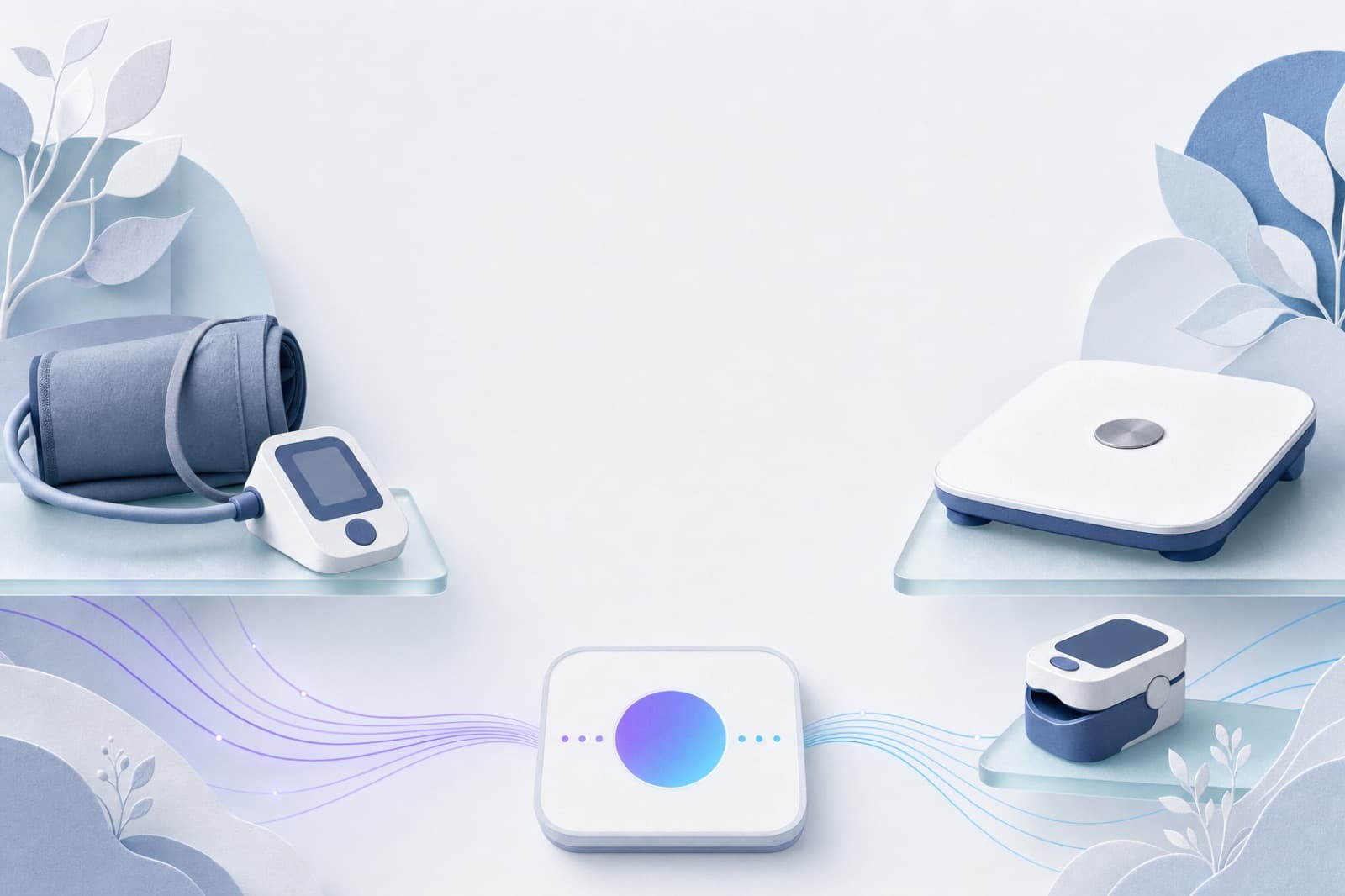
A continuous loop: devices on the patient’s side, software and clinicians on yours. Every reading is captured, contextualized, and routed.
Continuous vital sign capture
FDA-cleared devices stream blood pressure, glucose, weight, SpO2, and heart rate into the platform without patient effort.
Thresholds & alerting
Configure clinical thresholds per patient. Out-of-range readings escalate to the right clinician in real time.
Patient app & portal
A clean app for patients to view readings and trends — and a clinician portal that surfaces what needs attention.
EHR integration
Readings, time logs, and billable events flow into your EHR. Live with Tebra, PrognoCIS, eClinicalWorks, and AdvancedMD.
From eligibility to reimbursement.
Identify & enroll
We help identify eligible patients from your panel and handle the consent, shipping, and onboarding logistics.
Activate devices
Cellular hubs ship pre-configured. Patients unbox, plug in, and start transmitting — no Wi-Fi setup required.
Monitor & intervene
Our team reviews readings, flags outliers, and loops in your clinicians when readings cross threshold.
Bill & report
Time and qualifying readings are captured for 99453, 99454, 99457, and 99458 — submitted by our billing team.
FDA-cleared devices, cellular or Bluetooth.
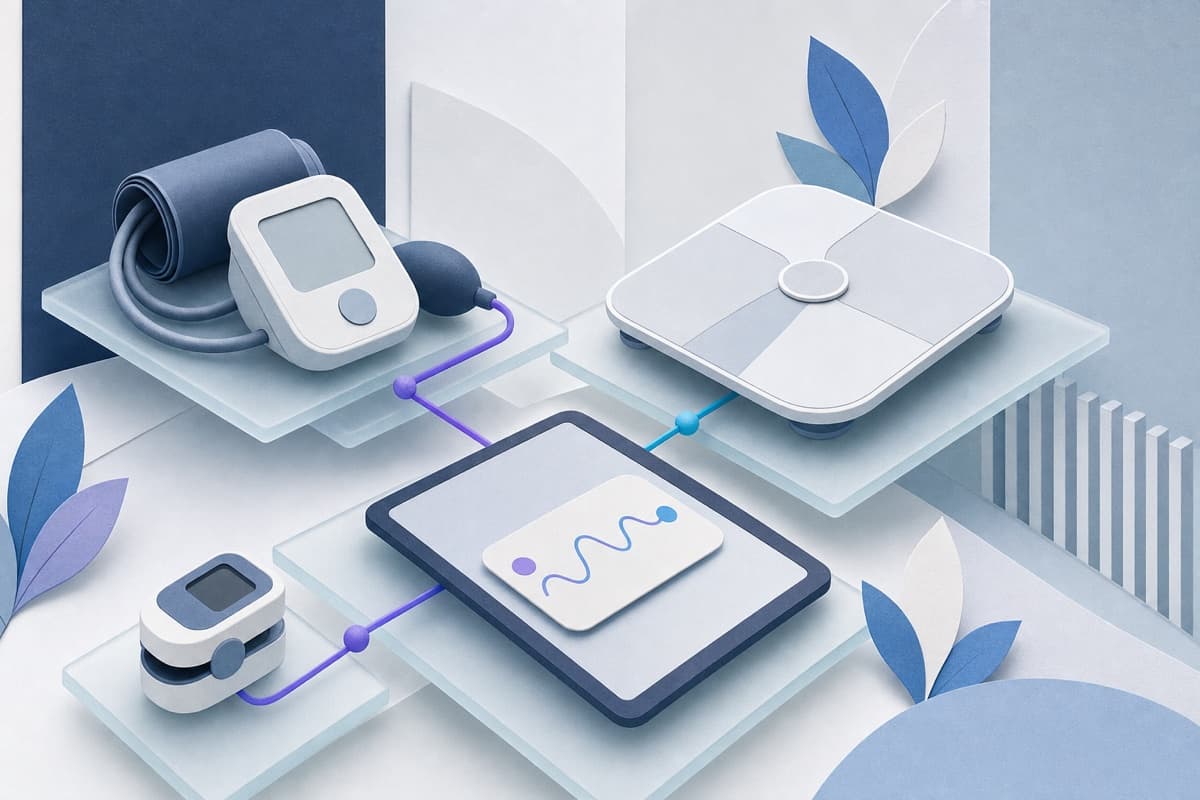
Choose the form factor that fits the patient. Cellular for the lowest-friction setup; Bluetooth where you already have a phone in the workflow.
Plug in and start transmitting.
Cellular hub
Central connectivity device with built-in cellular — works wherever there’s coverage.
Cellular BP monitor
Standalone blood pressure cuff with direct cellular transmission.
Cellular scale
Weight monitoring with cellular connectivity — no phone or hub needed.
Pair through the patient app.
Bluetooth BP monitor
Accurate BP readings paired through the patient app.
Bluetooth pulse oximeter
SpO2 and heart rate monitoring for respiratory and cardiac panels.
Bluetooth scale
Digital weight scale with Bluetooth pairing.
Rolling out next: integrations with consumer smartwatches and additional condition-specific monitors.
What changes when monitoring is continuous.
RPM isn’t about more data. It’s about catching the trend before it becomes a hospital visit — and creating durable revenue for your practice while you’re at it.
- Early detection of clinical deterioration
- Lower hospital readmissions
- Higher patient engagement between visits
- Better chronic disease control
- Cleaner handoffs across the care team
- Predictable monthly recurring revenue
The billable RPM building blocks
99453
Initial setup & education
99454
Device supply (≥16 days)
99457
First 20 min monitoring
99458
Each additional 20 min
Built around what your practice already runs.
The EHR you already use
Monitoring data belongs in the chart your clinicians already open, not in a second portal. These connections are built and maintained in-house, and the list is not closed.
In development: Athenahealth, Epic.
The specialty you practice in
What is worth monitoring, and what should trigger a call, differs by panel. Each specialty page names the measures, the escalation question, and the codes that commonly apply.
RPM billing and setup, answered plainly.
What CPT codes are used for remote patient monitoring in 2026?
The RPM family is 99453 (setup & patient education), 99454 (device supply, 16–30 days), 99445 (device supply, 2–15 days), 99457 (management, first 20 minutes), 99458 (management, additional 20 minutes), 99470 (management, first 10 minutes). National average reimbursement runs roughly $22 to $52 across the family; exact rates vary by locality, so verify against the CMS Physician Fee Schedule lookup. Full requirements for each code are in the CPT reference.
What happened to the 16-day data requirement in 2026?
It was supplemented, not eliminated. CPT 99454 now covers 16–30 days of readings in a 30-day period, and the new code 99445 covers 2–15 days — so months with fewer readings are finally billable. The two device-supply codes cannot be billed together in the same 30-day period; you report one or the other based on days of data received.
Can RPM be billed in the same month as chronic care management (CCM)?
Yes. Medicare allows RPM and CCM for the same patient in the same month, from the same or different practitioners, as long as time is tracked separately and no minute counts toward both services. Neuvora's platform tracks RPM and CCM time independently to keep the combination audit-ready.
Can RPM and RTM be billed together?
No. Medicare treats remote physiologic monitoring and remote therapeutic monitoring as mutually exclusive for the same patient in the same period — a practice bills one or the other. The CY 2026 final rule did not change this.
Is RPM considered telehealth?
No. CMS classifies RPM as an inherently non-face-to-face service that falls outside the statutory definition of Medicare telehealth, so telehealth geographic rules and waiver expirations do not apply to it. RPM billing was never at risk from the telehealth extension debates.
Who does the monitoring — Neuvora or our own staff?
Either — Neuvora supports both models. Practices can use Neuvora's clinical team for full-service monitoring, or run monitoring with their own nurses and medical assistants inside Neuvora's platform. The software, time tracking, and documentation are identical in both configurations, which also means practices can move between models without changing systems — relevant given CMS's proposal to require practice-employed staff for RPM starting in 2027.
Does Neuvora handle RPM billing?
Yes. Neuvora supplies FDA-cleared cellular-connected devices, documents monitoring time, and can manage claims end to end through its billing service — integrated with EHRs including Tebra, PrognoCIS, eClinicalWorks, and AdvancedMD.
Continuous care, ready to deploy.
A short scoping call is the fastest way to see how RPM fits your panel and EHR.